
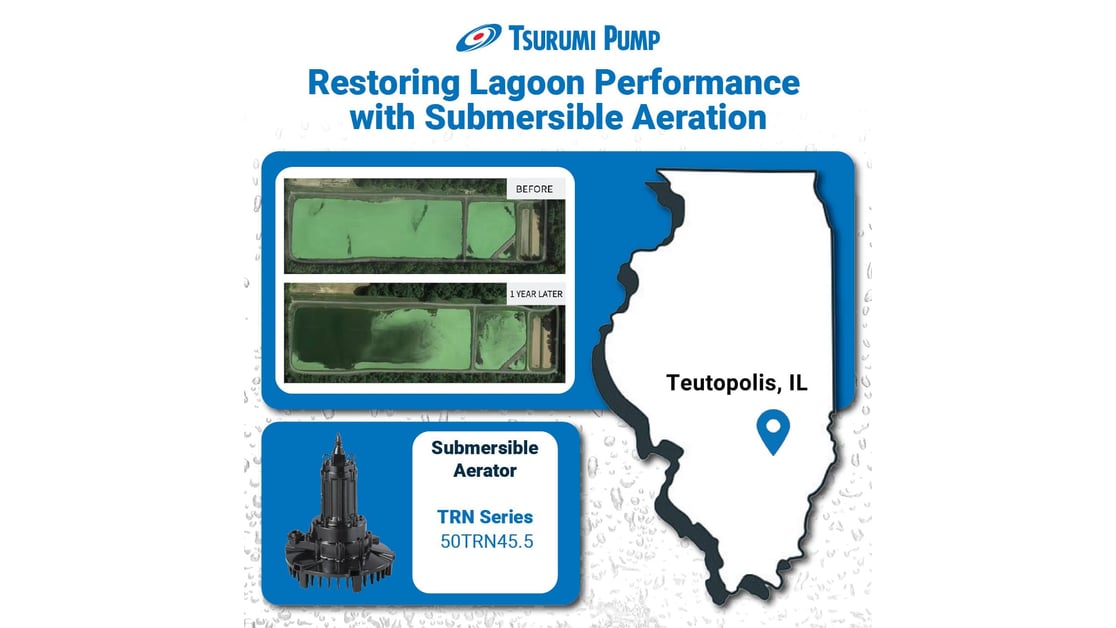
The City of Teutopolis, Illinois, faced a growing operational challenge with its municipal lagoon system. Originally constructed in 1976, the lagoon had accumulated nearly two feet of sludge over decades of use. With shallow water depths averaging just three to four feet, the system struggled to maintain adequate dissolved oxygen levels. Compounding the issue, newly established state limits for ammonia and nitrogen made compliance increasingly difficult..
Previous efforts to improve lagoon performance proved insufficient. Existing surface aeration systems primarily mixed the upper water column, leaving settled sludge, organic material, and nutrients largely undisturbed at the bottom. This stratification limited biological activity and reduced overall treatment efficiency. As conditions worsened, the city began preparing for a costly and disruptive dredging project to restore capacity..
Seeking an alternative solution, Teutopolis partnered with AquaTec and Tsurumi Pump to evaluate more effective approaches. Instead of proceeding with dredging, the city opted to install three Tsurumi 50TRN45.5 submersible aerator-mixers. Unlike traditional surface units, the TRN series is designed to draw water from below and discharge it upward, creating a powerful "bottom-up" mixing pattern. This approach re-suspends settled solids, distributes oxygen more evenly, and enhances microbial activity throughout the entire stratum. Notably, settled sludge serves as a carbon source for aerobic bacteria but remains largely unutilized unless it is re‑suspended into the active biological zone, where biodegradation can occur..
The impact was both immediate and measurable. Within months of installation, dissolved oxygen levels improved significantly, supporting more consistent biological treatment. Ammonia and nitrogen concentrations decreased, bringing the system back into compliance with regulatory requirements. Additionally, BOD5 levels remained well below permit thresholds, confirming improved overall treatment performance.
Beyond regulatory compliance, the solution delivered substantial operational benefits. By eliminating the need for dredging, the city avoided significant capital expenditure and minimized disruption to ongoing operations. The system’s submersible turbine style self-aspirating aerator-mixer, also reduced sludge accumulation, extending the lagoon’s functional lifespan. Furthermore, the system maintained a residual dissolved oxygen level in the effluent receiving stream, contributing to improved environmental outcomes.
Tsurumi’s submersible aerators were selected not only for their performance but also for their durability, ease of maintenance, simple deployment and cost-effectiveness—key considerations for long-term municipal applications. The success at Teutopolis demonstrates how innovative aeration technology can provide a practical, efficient alternative to traditional lagoon rehabilitation methods.
Download the story here.