
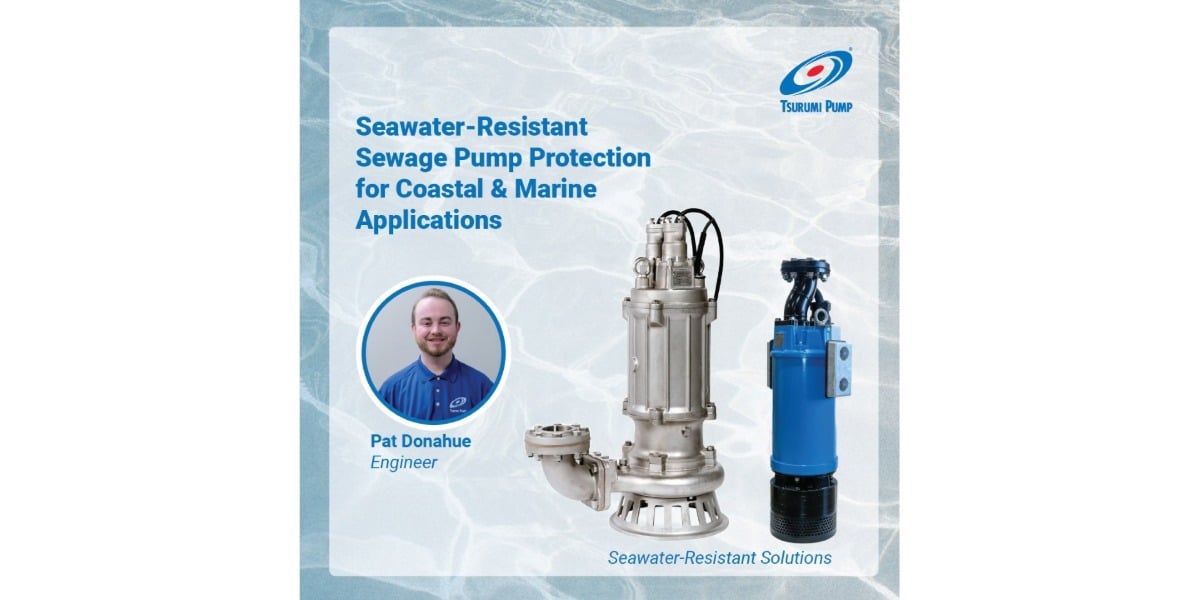
Tsurumi addresses ways to mitigate the unique challenges of pumping sewage and wastewater in seawater environments, including implementing corrosion-resistant materials, protective coatings, and sacrificial anodes.
Seawater presents a highly demanding environment for submersible pumps. High salt content, abrasive sand, and constant exposure to dissimilar metals can accelerate corrosion, degrade performance, and ultimately lead to premature pump failure if equipment is not properly selected. Corrosion prevention in seawater is not a one size fits all solution - it requires a combination of proper material selection, protection, and surface coatings. All factors work together to manage corrosion and abrasion over time.
Engineered Material Selection for Seawater Service
The most effective method to prevent corrosion when pumping in coastal and marine environments is through the proper selection of materials. Seawater environments accelerate corrosion due to an electrochemical reaction that occurs between dissimilar metals. Additionally, grit content is increased in coastal areas due to the presence of sand. To address this, 316 stainless steel contains a high chromium content which forms a self-repairing layer of chromium oxide that protects against corrosion when exposed to oxygen molecules. An alternative to 316 stainless steel is titanium, as it provides a superior level of corrosion resistance at higher temperatures in areas with lower levels of oxygen. Both 316 stainless steel and titanium are a higher price point than traditional pump materials, due to their corrosion resistance properties.
Protection Beyond Materials: Coatings and Sacrificial Anodes
A sacrificial anode is an alternative option that helps to protect the pump from seawater corrosion. The anode is made of a metal with low potential and is installed on the external surface of the pump. Due to the anode materials’ low potential, the anode will assume corrosion ahead of the critical pump components, allowing key components and sealing surfaces to remain intact. This solution is more cost effective than purchasing a stainless-steel pump, however it requires additional maintenance - operators must change anodes out once they are spent.
Another option for corrosion protection is coating metal components with a protective material to limit exposure against seawater corrosion. This provides a similar level of protection to stainless steel; however, unlike stainless steel, the coating is not self-repairing. Operators will need to routinely check the coating status to determine levels of wear.
Maintenance Consideration and Planning
As with any pump operating in abrasive or corrosive environments, routine inspection and maintenance remains critical. It is recommended that operators stock components that are prone to wear, including impellers, seal kits, gasket kits, and bearings. For critical installations, maintaining a backup pump on site is advised to minimize the potential of downtime. With the correct selection of materials and a disciplined maintenance approach, operators can achieve an optimized pump life cycle, even in demanding coastal environments.
Download the story here.