
In pumping applications, performance starts with selecting equipment that is built for the conditions that it will face. For submersible pumps, one indicator of a purpose-built design is the discharge.
Top and side discharge are often discussed as differences in design, but in practice, they reflect the demands of the application itself. From construction dewatering to wastewater handling, discharge design solves a specific set of challenges in the field.
Top Discharge for Dewatering Applications
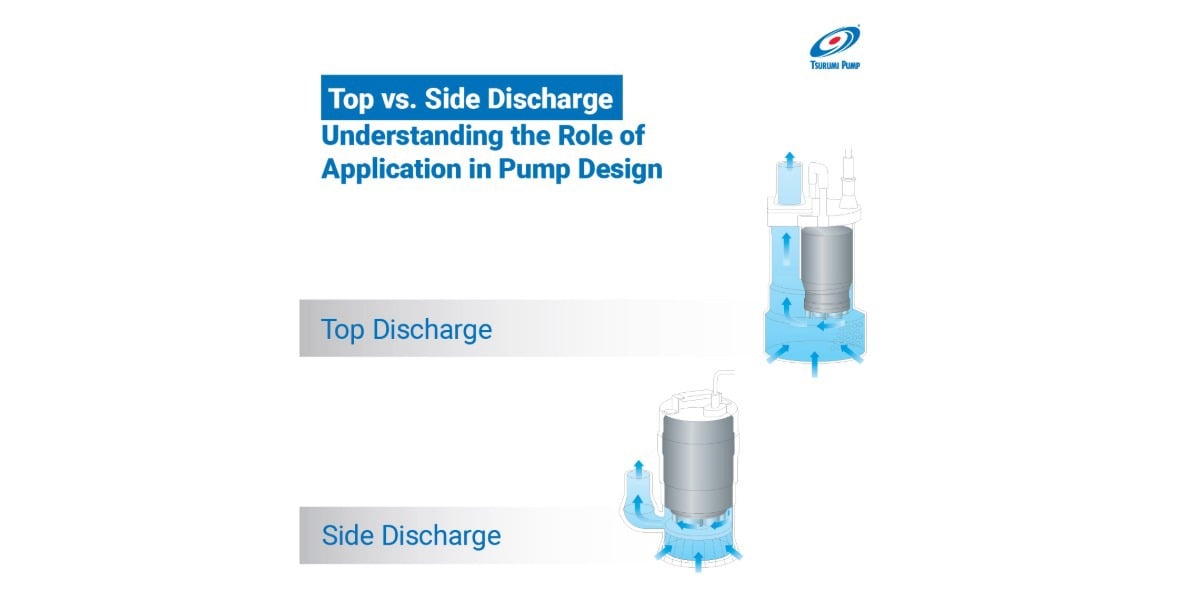
Dewatering applications present environments where pumps must continue operating at fluctuating levels, including construction sites, mines, and industrial plants. Top discharge pumps address this through a design that moves liquid around the motor before being discharged. This helps to ensure motor cooling in low level liquid scenarios.
Tsurumi’s LB Series, along with models such as the LSC, LSR, LH(W), and LH-D, are built around this design. By incorporating an inner and outer motor casing, these pumps allow water to pass completely around the motor as part of the discharge path. The result is a design that is well-suited for continuous operation at low water levels and extended run time. In applications such as construction sites or mines, where water space is limited, this approach helps maintain performance and reduce interruptions. Dewatering pumps are often lowered into deep holes or well casing, therefore the top discharge design prioritizes convenience in these scenarios.
Side Discharge for Wastewater and Solids Handling
In wastewater and sewage applications, pumps must be able to handle solids while operating efficiently over long periods of time. Integration into systems such as lift stations is an additional factor to consider. Installations often rely on guiderails, where pump orientation and discharge alignment play an important role.
Side discharge pumps are designed with these factors in mind. By positioning the discharge outlet on the side and integrating it into the motor casing, the design supports a more direct flow path while still allowing water to pass along the motor for cooling. This provides higher levels of efficiency in comparison to a top discharge design.
Application Driven Design
Pumping conditions vary widely for different applications. Water levels fluctuate, space can be limited, and the presence of solids can dramatically impact performance. As a result, submersible pumps are not designed as one-size-fits-all solutions. Instead, the selection of the pump pertains to a variety of factors, including the application and operating conditions.
Download the story here.